Everyone loves to hate on old timey food. More than that, everyone loves to write (and Vlog, and even Podcast) about their hate of old timey food. And hating on old timey food has, in recent years, become more popular than ever it seems.
B. Dylan Hollis, for instance, has become famous on TikTok for his videos in which he finds some absurd sounding recipe in an old cookbook and goes through the process of making and tasting it on camera. And while I admit I haven't watched every possible TikTok in his roster, of the ones forced on me by friends it appears that most of the time he complains- as people usually do in videos such as these. Occasionally, however, he's genuinely shocked to find that what he's made is actually good. Some of these times he seem mad, even, that they came out pleasant- as if something from so long ago, with such a stupid name and such ungodly ingredients, shouldn't legally be allowed to taste acceptable.
Of course, Hollis is far from the first person to do anything of this sort. Youtube star Angela Clayton has made both a 1913 Sunday Dinner, and an unspecified 1930's Dinner for her "Cooking in Costume" mini series three years ago now. Many others have been producing similar blog, video, and audio content in the vintage community for decades- some well before Angela Clayton was ever producing content at all... The popularity of Hollis' videos has, however, increased the volume of such videos as more people find "interest" in vintage and antique- and even historical- recipes.
Unfortunately they all come for the same reason- and that reason is not (or is at least very rarely) any kind of genuine interest. Instead they come for the express purpose of doing what people have always done: Picking the wildest recipes they can find for the sake of complaining; to treat people of the bygone as mere things to be laughed at, as having been too backwards to function- instead of real people, our ancestors, simply making do with what they had. And in nearly every case, these people lack the historical knowledge and context at all necessary to properly understand what it is they're even consuming- and why it may have existed in that manner in the first place.
Such lack of knowledge is probably most evident in the case of another TikTok making the rounds on Tumblr at the moment. In it a different individual (this time one @mort_allie) is making a fuss about "Toast Tea"- a drink made by soaking well toasted bread in water, removing it, and then aerating it between two pitchers. After tracking down the original video on their TikTok, Natalie doesn't provide a very good source outside of saying that it's a recipe from the 1870's from 'The Modern Householder', so I had to do a bit of digging on my own. And it appears there's two versions: The Modern Householder, and The Model Housekeeper. While The Model Housekeeper is still available online, The Modern Householder is not. Both, however, still bear the same publication date from 1872 by one F. Warne, as well as the same byline: "A Manual of Domestic Economy in All Its Branches".
When it was posted to Tumblr, however, the user @blondekidwithgatoradebottle was somehow surprised to find that the same recipe still available in their copy of the New American Cookbook published in 1946. And as one would suspect, people in subsequent reblogs lost their minds about many of the other inclusions in the photo that @blondekidwithgatoradebottle posted of their recipe book: Beef Tea, Beef Juice, and Raw Beef Tea; reactions were as negative to those as they were to the Toast Tea of the original video. But as someone eventually stepped in to say: These recipes serve a purpose. And that purpose was, in this case at least, to feed the sick and invalid.
Indeed, in my own browsing, I came across all three and more in several homemaking Exemplum nearly a decade ago now. So their reappearance just last year in A Handbook of Invalid Cooking, for the Use of Nurses in Training Schools, Nurses in Private Practice, and Others Who Care for the Sick, originally published in 1893, was no surprise to me at all- and this one is in my own collection; Beef Juice, Beef Tea, and Broths open the section on Recipes right out the gate, with Toast Water following on page 101. Their continued reappearance as late as 1946 doesn't surprise me, either- though that kind of medical care had gone a little bit out of fashion by then.
It's ironic, actually, just how often the recipes people who want to poke fun at the food of yesteryear wind up picking, wind up being just like this: Foods that were given to the ill and invalid as easy to digest nutrients. In some cases, even, the dishes come from impoverished diasporic communities- such as African Slaves, pre and post enslavement both. Others are region specific dishes often coming from the American South in particular. And there's a history there not only tied heavily to diaspora and immigration and the issue of racism, but also to classism and regional discrimination and how those two intertwine as well (especially with the former topic). Or they're foodstuffs developed during times of incredible poverty; recipes from the 20's and 30's are often prime-picked targets for their strange ingredients, but how many who eat them for the ability to grimace on camera (and hopefully go viral) care about the Great Depression and the Dust Bowl that made them necessary in the first place?
On top of being your average old fashioned anachronistic shitbagging... Intentionally participated in or not, this kind of anachronistic poking is also often an insidious form of racism, abelism, and classism. And it's especially disappointing to see coming from someone who, at first glance at their video feed, actually seems to enjoy the anachronism itself. Yet it's not actually all that surprising. Indeed, those interested in anachronism are often the ones who feel the need to participate the most strongly in such behaviors in order to validate their interest in the anachronism; it's a way of saying
See! Look! I don't like everything. I don't agree with it all. I'm not backwards like they were!
It's nonsense, of course. But you find it just as easily in the Midcentury oriented community as well- perhaps more so, actually, with the rise of the Tradwife who often manifests herself cheerfully beneath a Vintage 50's veneer. And here, too, everywhere you look, articles upon articles about the 1950's consistently mention the wild west of 50's cuisine- from relatively tame ones like Atora Steak Puddings, to questionables such as Ham and Bananas Hollandaise, and right down to the right too-weird-to-mention. But within the midcentury, everyone's favorite target isn't a symbol of the lower classes. Quite interestingly it's actually the opposite. And it might be one of the few cases where that actually is the case- though that doesn't make it any less annoying.
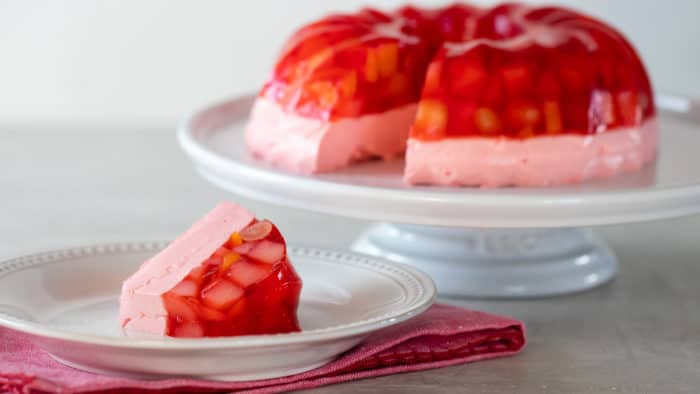
I'm talking about Jell-o, of course, because it's not the 50's without the seemingly ubiquitous (and dreaded) Jell-o mold... But as I keep reminding people, food and fashion are both heavily entwined with both politics and prosperity- and Jell-o is certainly no exception to that rule. Indeed, every generation has their weird food items, as we've illustrated perfectly well with all of this nonsense. Jell-o just happened to be the main 50′s one for reasons including- but not limited to: A massive economic boom, the subsequent expansion of the white suburban middle class, an increased availability of in-home refrigeration, and wartime innovation needing to find a place on the civilian consumer market- and more.
Jell-o itself as a brand may have been ubiquitous to the 50's, though, but gelatin certainly wasn't. Others have articulated the history of Gelatin far more concisely than I ever could, however, and so I'll defer you to them for guidance- including the Jell-o museum itself, What's Cooking America, and Serious Eats.
Yet- and this is the truly important bit: Just because something appeared everywhere, it doesn’t mean it was actually widely consumed. And if Toast Tea is the epitome of people hating food without the proper historical context and knowledge to actually understand it? Then the dreaded Jell-o Mold of the 1950's is the epitomical example of people forgetting that media depicts the ideal, and not the reality; it's everything that's wrong with the way we view 50's food today- and perhaps the way we interact with old media in general. But the reality is, there's not much of a difference between media now, and media then.
Here's a little test, as an example: How many of you have actually went out and purchased a real modern cookbook to flip through (instead of just Googling recipes and then complaining about longstanding blogging traditions you refuse to grasp the significance of, just because it takes you a little extra bit of scrolling to get to the recipes)? Now how many of you actually flip through- or better yet, even, cook out of- any of your cookbooks regularly? Because I collect cookbooks both old and new, and I cook out of all of mine fairly frequently. And I can tell you the modern ones aren't actually all that much different from vintage ones that I own.
Sure, our tastes have changed over the decades. Our technology has progressed as well. And a lot of the time it's fairly clear that the progression of taste and technology has occurred in lockstep. But whether you're looking a modern cookbook or old one, most contain reasonable recipes that could be considered fairly tame or normal eats, interspersed with more exotic ones meant to impress for a special occasion or celebration, and sometimes a truly weird or wild showstopper or two will appear; unless you get a highly specialized cookbook, or a very niche one, that formula is fairly consistent.
Yes, a lot of truly weird ones do still exist in cookbooks anyways, especially according to modern tastes and sensibilities- often for reasons we don't fully understand today, as we're missing important socio-historical context you can only have in the moment (or through a lot of studying). And yes, one or two of those may’ve actually made it onto a table- especially as a statement, or as a way to show off on occasion, or even just due to weird subregional and subcultural trends; Aspic is still very popular in several regions of America today... But it was a far cry from today’s increasingly annoying trend of “let’s pick literally all of the worst, weirdest possible recipes we can find and make a full course meal out of it all- then complain about how backwards and strange the people of yesteryear were”.
We can’t ignore the fact that media has always represented the cultural ideal- never the cultural reality (which is usually significantly more tame). And in that regard, in general, the dishes of yesteryear really weren’t all that much different than what we eat today. More importantly, in every case they were a product of their time, and what was available. And we cant keep ignoring that fact and keep picking the most extreme examples of a decade's food and calling it even- let alone accurate.
Comments
Post a Comment