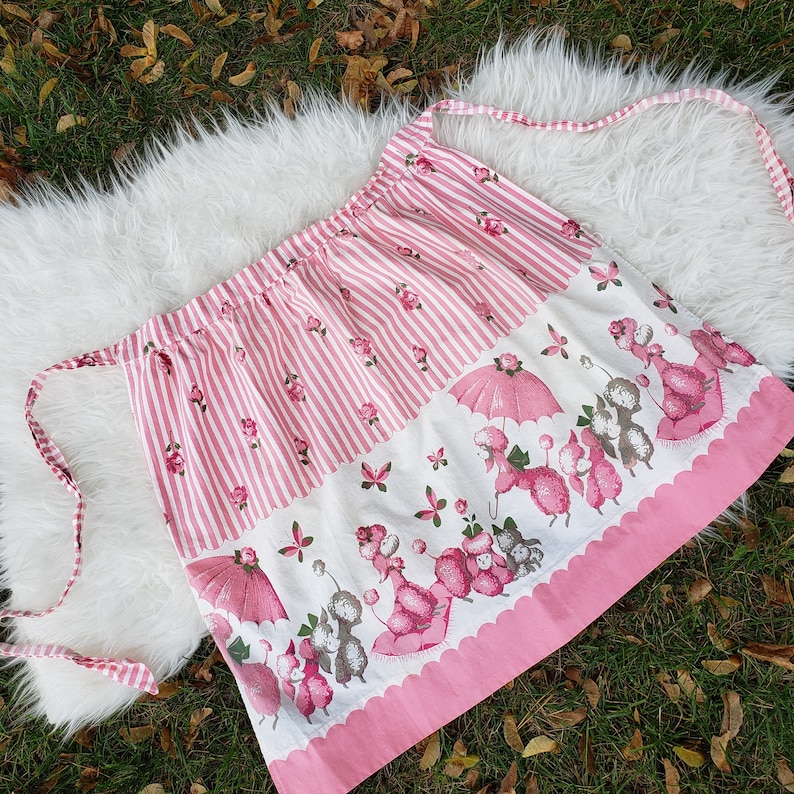
Seeing Homemakers everywhere traipsing about, cleaning and cooking in beautiful hip aprons made from thin fabrics adorned with delicate trims and detailed embroideries... Frankly, it gives me a load of anxiety. This is doubly true when those thin, pretty little aprons in question happen to be true vintage darlings they boast about having scored somewhere like Etsy- known for being a haven of real vintage shopping.
Of course it's just for the aesthetic, and that becomes clear the second they open their mouths; most who call themselves any variant of a 'vintage housewife' these days don't have any legitimate clue about anything outside of the way we've twisted the visual imagery of the propaganda set. There's no depth to their knowledge- nor do they care to actually seek it out. To them, it's all about the modern caricaturized image of the pinup housewife... Today's Stepford Darling, as I tend to call her anymore; any attempt to bring even the most minuscule amount of reality into the mix is met with deleted comments, denial, or even outright vitriol.
This near universal refusal within the Vintage and Vintage Homemaking communities to put aside their rose colored glasses, and put down their copy of The Good Wife's Guide, for even just two seconds is why Unfashionable Housewife was started in the first place. It's also why we're going to be talking about Aprons today and why, with aprons falling by the wayside as a household work garment in the modern era, it's actually a lot more complicated than you know. And those complications are very important to know, especially if you want to actually protect your clothing.
First, I want to talk about those beautiful Hip Aprons that everyone's so obsessed with. Because while some thin ones are ones you can wear while doing minimal work? They simply aren’t proper cleaning aprons. In fact, if you clean in those very thin ones like that, there’s a very high chance they won't actually protect your clothing at all because they're so thin. Which means that you'll not only ruin your dress, but you'll also ruin the apron right alongside it- which is an absolute travesty when they’re usually true vintage.
Indeed, they were intentionally made for beauty over function- much like many of the dresses I see most participating in those "50's Housewife for a Day" challenges weren't what real homemakers would have worn traipsing about their houses cleaning, either. But they would have been worn for walking to the market or going out around the town; what they would have worn with their real aprons would have been a much plainer Day Dress. In the 50's in particular this would have been a (usually plain or geometrically printed) Shirtwaist Dress made from a sturdy, easily washable material that could have taken the beatings of daily labor, and held up well to the regular washings they would have needed.
In other words: Homemakers should cease wearing these thin Aprons to clean; they didn’t do it in the 50′s for obvious reasons, and neither should we. We should really do away with our beloved Hip Aprons in general, though; yes, I know, they're shown everywhere in media. But they do so little for us in terms of protection during some of the most important tasks you'd really want an apron for in the first place.
In nearly all cases, the common Hip Apron is far from being sufficient for the task. But if the flimsy, lace thin aprons were never meant for cleaning in the first place- and the Hip Apron is to be (mostly) discarded altogether in general... Then what is it we're supposed to be wearing?
The important thing to remember is that an apron's entire purpose is to protect your clothing from damage and danger- such as from acids, dirt or other stains, allergens like dust, cleaning products, or even excessive heat. But while the Hip Apron appears to be the most common, it isn't the only style to exist. Over the years, many different styles have developed. Not all of them are created equally, however, and these design differences aren't just for aesthetics. Indeed, each design and fabric choice has a distinct reason for its existence, and was often designed to best suit different tasks.
Unfortunately the knowledge of which aprons are which- and which are better for what- has clearly been lost to most over the years outside of seemingly everywhere but a handful of specific professional industries. So let's go through a hypersimplified list of some of the most common ones, from least to most coverage, shall we? Starting with that Hip Apron that's so beloved by the Vintage community.
⚶ Hip Aprons ⚶
Half Aprons, also known as Hip Aprons, are those that tie around the waist and only offer protection from the waist down- although some variants which protect from the underbust down do exist. These are atypical, however. All Hip Aprons can be divided into two basic categories: The regular Protective ones, and the Decor ones people frequently mistake as being protective.
Protective Hip Aprons are meant (as the name suggests) to protect the clothes during cleaning tasks when the top half of your body is less likely to be in contact with surfaces. For this reason they tend to be thicker and made from a sturdy fabric that's easy to wash as a result. That doesn't mean they can't be fashionable, though. Typically, however, the fashionable elements of a protective apron came from the shape of the bottom edging. Handkerchief shapes, scalloped edging, and long ties to produce very big bows, were all common in old patterns. And in the modern era, the use of patterned quilting fabric has become popular not just for its durability, but also the ability of patterning to hide stains.
Decor Aprons, the other type, can also be known as Party, Hostess, or Dust Aprons. And unfortunately these are the kind of apron I most often see people frolicking about in, in their various photos and videos. Despite the last name, however, they are not commonly meant for cleaning and are meant (as suggested by the first three names) entirely for decorative purposes; traditionally this was the apron that the Hostess of a party would have switched to after all of the cooking and cleaning had been done, in order to receive their guests. For that reason they don't need to provide as much coverage or even protection. They just needed to be pretty. As a result, these are made of finer, thinner, more ornamental fabrics like chiffon and crocheted lace even. They're also most likely to have trims, complex embroideries, and other embellishments. For this reason, dust aprons are also often the ones that require careful care and washing, making them incredibly impractical to actually get dirty- as anyone who owns a true "hand wash only" garment can attest.
If you do wish to use your Dust Apron for cleaning, the appropriate way to use it is for the lightest of the light work in your household: Dry dusting; your apron and your torso should not be coming into contact with wet dust, or with any other form of contact grime. And it certainly shouldn't be used for cooking or other more serious acts of cleaning.
⚶ Cobbler and Tabard Aprons ⚶
Cobbler and Tabard Aprons are the second category and offer front and back coverage to the wearer. But where Hip Aprons focus on the lower half, these aprons focus on the upper half, and so have little to no lower body protection. Cobbler Aprons will have partial or full coverage for the back, typically using crisscross straps. Tabard Aprons, however, will have full coverage on both sides. Additionally the front and back are a single piece connected at the shoulders; the Apron slips over the head, then fastens at the side with ties or tabs.
Typically you'll see these in educational and medical settings, art studios, and the like; areas where it's common to get dirty on the upper torso more-so than the lower one. But that doesn't mean they don't have a place in the home. Indeed, as somebody who has hand washed all of her dishes until very recently, I've found they're great for protecting my clothes from water and food splashes during the process- especially since they're usually made with more durable fabrics, and are meant to stand up to heavier messes. Unfortunately most are usually plain and not embellished. Although that doesn't mean you couldn't embellish one if you wanted to.
⚶ Bib Aprons ⚶
Bib Aprons, the third category, are a variation on the Hip Apron which provides torso coverage as well. Usually this is in the form of a long torso tab affixed to the top; older variations on the Bib Apron kept this tab in place by fastening it to the top of the breast with pins. Modern variations, however, bless us with straps and ties that allow us to fasten (or sometimes slip) it over our neck to keep it in place. This tab is thinner and doesn't provide full frontal coverage to the same level that a Tabard or Cobbler Apron does, however.
If you need both upper and lower torso protection at the same time, a Bib Apron is not only the most common apron that you'll see for sale for the home, but it's the one you'll most likely reach for- especially for cooking. And like with Hip Aprons, Bib Aprons can be (and are often) made fashionable. This includes modifications of the bottom edging- but also includes the shape of the top neckline; sweetheart necklines are particularly common in older patterns, as are scalloped necklines. In the modern era, too, you'll often see these in a myriad of patterned fabrics.
⚶ Smock and Pinafore Aprons ⚶
Bringing in the fourth category are Smock and Pinafore Aprons. Stylistically speaking they're something of a cross between a Cobbler Apron and a Bib Apron in that they have the high neckline and wide torso to provide complete front coverage, but are also long and provide significant lower body coverage as well. And with a typically crisscrossing back, they provide no or only partial back coverage- not the full back coverage that Tabard Aprons do.
These are incredibly versatile aprons, however, typically made of plain, and very sturdy materials with large pockets in the front. For that reason, you also see Smock Aprons a lot more commonly in industrial or professional settings- typically in the same educational and medical settings. But they too have great home use as well; heavier duty ones made from canvas, burlap, or corduroy may sometimes be waxed for waterproofing, making them especially great for outdoor tasks like gardening as they provide superior coverage from dirt and grime, and are heavily tear resistant.
Pinafore Aprons aren't quite as heavy duty, however, and are sometimes a little bit more embellished. Instead, they're often made from plain quality cotton or linen, and are meant largely for indoors around the house. These are incredibly useful during heavier duty interior cleaning tasks, because of their ease of bleaching and full coverage- one reason they were predominantly made from white linens back in the day; if you've ever seen a typical Edwardian Maid's uniform, you've seen a typical Pinafore Apron, and they are great.
⚶ The Bungalow ⚶
A little known apron style, however- our last one- is the Bungalow style. And if you really want full protective coverage, these are where you really want to go... Although frankly I think they're overkill unless you're a professional cleaner outside of the home. In which case the full dress protection of the Bungalow Apron may just be what you'd want, no uniform almost necessary.
They've fallen out of fashion quite a bit now, but Bungalow Aprons were made out of a crisp, usually patterned, but still sturdy material, fashioned essentially into a dress; the style of the apron itself changed as the popular fashion styles changed over the decades, but most followed a few main tenants: They preferred using as few cuts as possible, often even cutting the sleeve and bodice as one- and they tried using the fewest fasteners possible while still maintaining a snug, safe, and protective fit; they provided you with complete and total protection for everything but your sleeves... Except you could add sleeves, and there are many styles that did indeed have them.
They fell somewhere between Nightclothes and a Day Dress, though, on the acceptability scale- being intended only for in-home wear, and never as an outdoor garment. They were also intended as a stand alone garment, with only the usual undergarments worn beneath. But as times progressed, you can see more examples of patterns and uses where blouses and other articles of clothing (sometimes what looked like full dresses) are even worn beneath. So it's safe to assume that you were essentially getting some kind of an overdress that you could either wear with a dress, or with just a blouse and slip. So it's really up to you.
Of course, these are far from the only apron styles to exist. There are several categories I didn't even cover here- not to mention innumerable apron styles which pick and choose elements from various categories and fit into none of them at all; the 50's alone was an era famous for its variety of apron patterns, and the sheer inventiveness of its styles. There's certainly something out there for everyone (and everything).
On that note: While it's important to understand the function of aprons, and what they're best at? It's not necessary to have exactly apron (or more) of every single type laying around your house, to be used for each specific task they're best suited for- and nothing else. This knowledge is so that you can actually pick what you legitimately need instead of using substandard aprons because that's what you see.
Personally, I only have a handful of aprons. I have two cute Bibs- one patterned one with a built in hand towel for regular cooking, and a plain light colored one for baking. And then I have a hand sewn vintage Dust Apron for parties; I used to have a waxed Cobbler Apron as well, but I tossed it when we got the Dishwasher this year. I may add a nice, thick linen Pinafore next year for my Gardening, though; I need something durable and garden resistant, with plenty of material to gather my harvests in since I'm always forgetting my bucket- but that's also easier on my decades old washer to handle than a weatherproofed burlap.
It can't be ignored, however, that an apron is a practical garment. A working garment. "What you need" not only needs to include actually performing the task you need it to (in other words: Protecting you to the level you need, from the specific things you need protection from)... But it also needs to be able to hold up to what you throw at it. And the fact of the matter is, Hip Aprons rarely do that.
Unless, of course, you're just not doing any real work in the first place.
Comments
Post a Comment